
Jisc is working in partnership with Welsh Government to drive forward Digital 2030, which aims to see learning providers in Wales harness the potential of digital technology underpinned by principles of innovation, collaboration, co-production and social partnership. To support this, Jisc has sourced and developed six examples of successful collaborative initiatives using digital tools and technology in post-16 learning and teaching in Wales. We outlined the key success factors for these case studies and showed where each collaborative approach could be scaled up or was beneficial to address particular issues or subjects. As a whole, these case studies offer an insight into the exciting possibilities opened up by collaboration within and across sectors, enabled by digital technology, when partners in a collaboration share a common vision and sustainable approach. Key themes supporting Wales’ digital ambitions The case studies can be seen as exemplars of the four key national priorities outlined in the Welsh Government’s call to action for FE institutions in December 2022: Work collaboratively to widen access to learning opportunities Develop learners’ and staff digital capabilities and confidence for learning, life and work Maximise the potential of technology to empower, enthuse and inspire learners Embed agile, resilient and sustainable approaches to delivery The case studies The six case studies encompass colleges across Wales and collaborations across FE and with sixth forms, HE, work-based learning and community learning (see Appendix 1). The digital tools and technology in use range from virtual classrooms and virtual reality technology to apps and collaboration platforms such as Microsoft Teams. In brief, the case studies cover: Digital Diamonds: an active Welsh community of practice helping practitioners and managers deliver Essential Skills Wales (ESW) Digital Literacy across post-16 education and training. Educ8 and CEMET (University of South Wales): developing virtual reality resources for work-based learning through a collaborative approach with HE and employers. Growing Comms: installing connected active learning spaces in HE and FE through cross-sector collaboration, with strongly positive impacts on learners. St David’s WeConnect: collaboration between sixth forms to provide a wider curriculum through virtual classrooms. Target Tracker: colleges working collaboratively to develop digital tools to support learners with additional needs. Urdd Gobaith Cymru and the Gwreiddio Scheme (Coleg Cymraeg Cenedlaethol): developing Welsh language skills through collaborative learning for apprentices and teaching staff.

JISC Case Studies: Digital Collaboration in the Post-16 Sector

Tasks to develop and assess Teachers' Language Skills
This is a collection of tasks that can be used to develop and assess the language skills of education practitioners against the Language Competency Framework for Education Practitioners. The collection includes tasks for each skill and each level within the Framework. There is a PDF booklet for each level, containing all of the tasks for that selected level. In addition, the tasks are available to download individually in the form of Word documents. If the links do not open the document in a new tab, then the document will have downloaded (look in the downloads folder on your computer).

GCSE Mathematics Revision Guides
Revision guides kindly provided by Coleg Gwent to assist students and learners sitting Maths GCSE exams. There are separate guides for the foundation and intermediate levels.

About Health (Am Iechyd)
A series of Welsh medium podcasts discussing topics related to health and social care.

Creating and Using Bilingual Resources
This collection includes a blog and a recording of a webinar on creating and using Welsh medium and bilingual resources that were created by JISC in summer 2021. The blog is bilingual and the webinar is in Welsh with bilingual slides. Guest contributors to the webinar included the Coleg Cymraeg Cenedlaethol (Dr Lowri Morgans, Joanna Evans, Mary Richards and Enfys Owen), Welsh Government (Gareth Morlais) and Sgiliaith (Helen Humphreys).

Meddwl.org Website
The meddwl.org website was set up in November 2016, and is run by a small group of volunteers, to try to address the lack of Welsh-medium information available to help people living with a mental health condition, and their families and friends. This is the first website of its kind that contains information on mental health issues exclusively through the medium of Welsh. Everyone has mental health. meddwl.org is a place to get support and information, and to read and share mental health experiences – all through the medium of Welsh.

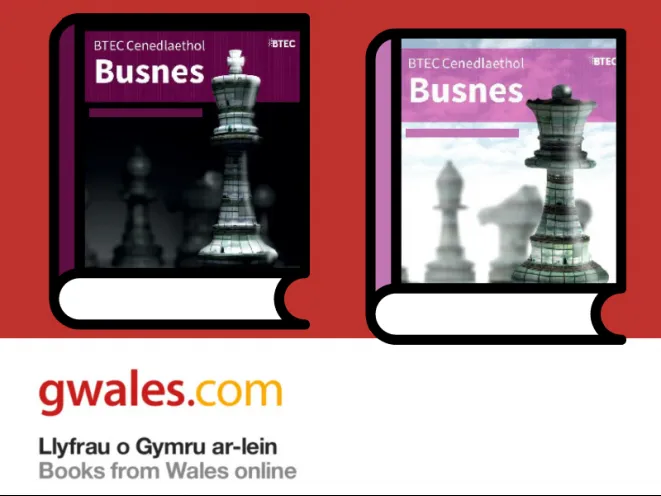
BTEC National Business Coursebooks
A Welsh adaptation of Pearson BTEC National Business - Student Book 1 for students following the BTEC Business Certificate, Extended Certificate and Foundation Diploma. It provides support through all compulsory units and a range of choice units, e.g. Exploring Business; Developing a Marketing Campaign; Event Organising; and Customer Services Enquiries.
Which Career Q&A Session: Law or Criminology Degree
These are recordings of two online sessions that were arranged for pupils who are considering studying LAW or CRIME at the University. The sessions provided a good opportunity for prospective students to get an idea of the type of career they can follow with a degree in those subjects. In the first session there are contributors who have graduated in Law or Criminology and are now working in those fields. The second session includes contributors who have graduated in Law or Criminology but went on to pursue a career beyond those subjects.
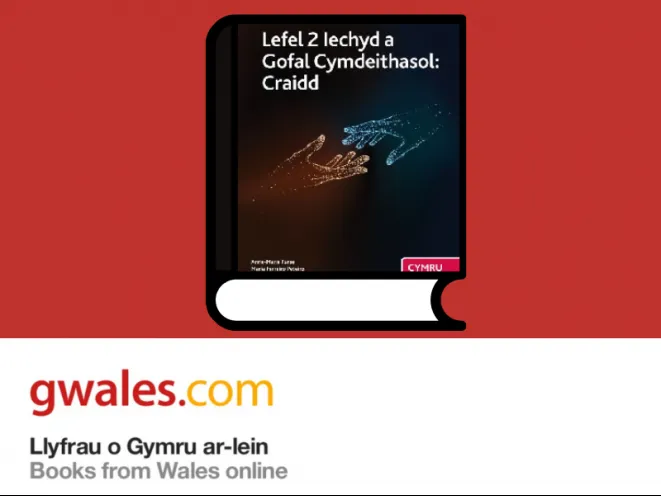
Level 2 Health and Social Care: Core Coursebook
A Welsh adaptation of Level 2 Health and Social Care: Core (Qualifications Wales), that was developed by Hodder in partnership with City & Guilds. This book is for post-16 learners in Wales who work, or want to work in, the health and social care sectors. It covers the seven core units of the qualification and will also prepare students for the MCQ exam which is assessed externally with the assessments assessed internally within the institution. The textbook covers a basic knowledge and understanding of the All-Wales Founding Framework for Health and Social Care and reflects a variety of different roles and settings. It includes: • Health and social care principles and values • Health and well-being • Professional practice as a health and social care worker • Protecting individuals • Health and safety in health and social care.
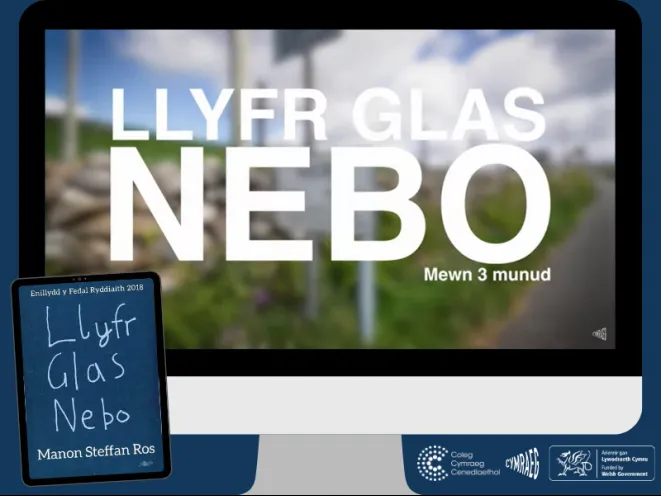
Llyfr Glas Nebo in 3 minutes
A new video resource that presents and summarizes the main content, themes, and characters of Llyfr Glas Nebo by Manon Steffan Ros, for the GCSE WJEC Welsh Literature Unit 2 course. The video aims to present the novel in a simple and memorable way, encouraging learners to study further. Welsh subtitles can be selected on video in YouTube. Funded by Welsh Government.
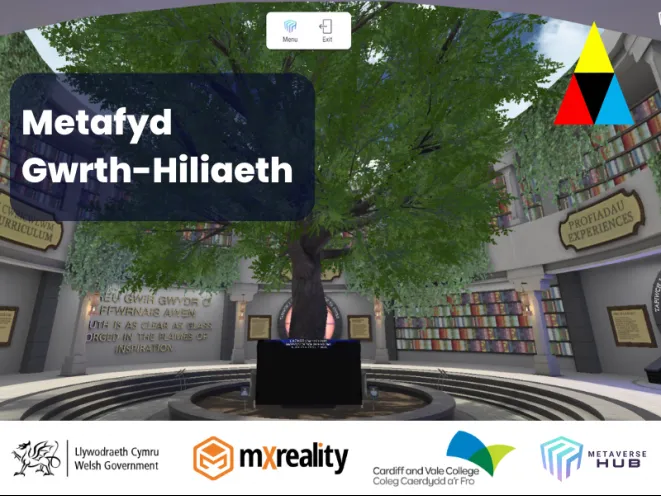
Welsh Government Anti-Racist Virtual World
In collaboration with mXreality, and working with teams specialising in the subject from Cardiff and Vale College, the Welsh Government has developed an immersive, accessible and expansive 3D metaworld environment, comprising of five areas relating to different themes. They look forward to sharing their experiences, stories and anecdotes with you, and you are invited to engage in an immersive learning experience, which will enhance your understanding of the world. As you explore this world, you are asked to engage with the resources and reflect on their significance. This is an opportunity for you to learn about the cultures and traditions that make up part of our shared identity. The Metaworld consists of the following sections: Experiences The Metaworld of Experiences is situated on a street of representative semi-detached houses in Wales, with access to six houses (three on each side of the street). In each of the houses, you can learn more about the background and interests of the individuals who live there by watching the video playing on the TV and by clicking on some of the interactive items (identified by a three spot icon) in the living room. Immersive Studies The Immersive Studies Metaworld consists of a main lower level area and three upper level areas. The main area has a variety of items of geometrical interest because of their shapes and patterns, which show the connection between mathematics, science and nature. You can learn more about these items by clicking on them. A QR Code is also visible on a panel near some items, which can be scanned with your mobile phone's camera to view a 3D or Augmented Reality (AR) version of the item on your device. The higher level includes: Mathematics room – allows visitors to explore the importance and history of mathematical and geometrical numbers and shapes Hair and Beauty Room – allows visitors to familiarise themselves with the history and origins of hair and beauty Inventions Room – educates visitors about some significant inventions and early contributions to contemporary life World Timeline The World Timeline Metaworld consists of a main central area and four geographic regions, all of which you can access via a tunnel from the central area. Each tunnel displays information that presents the background, identity and image of a representative individual from that region. Each of the four regions (detailed below), comprises four time periods, allowing visitors to experience architecture, images, and representational information in relation to ancient times, medieval times, early modern times, and the world today. The four regions available in this Metaworld are: Africa, Indian Subcontinent, Middle East and Northern Europe. As you move around the world timeline, in the central area and in each of the regions, interactive items you can click on link to videos that present useful additional information. QR Codes are also available in some of the regions, which can be scanned with your mobile phone's camera to view a 3D or Augmented Reality (AR) version of the item on your device. Curriculum This section allows you to engage with a wide range of carefully crafted topics in order to surmise that their plan will be anti-racist. The section consists of the following topics: Sociology Hair & Beauty Health and Social Care Black Feminism Politics Mathematics Film Studies African philosophy English for speakers of other languages Basic Education for Adults Additional Learning Needs Tutorial
Am Filiwn: Podcast
A podcast that discusses aspects of education that help pupils along the road to becoming Welsh speakers, in the context of the target to reach a million Welsh speakers by 2050. The podcast will appeal to anyone completing a teacher training course, newly qualified teachers, or anyone who’s already part of the education workforce. It’s also likely to be of interest to anyone who wants to know more about the role of the education system in reaching a million Welsh speakers. It is also an excellent resource to support the Welsh Language Competency Framework for Education Practitioners.