This document presents findings and practical recommendations on how health and social care education providers can increase students’ use of Welsh. Drawing on research evidence, it explores the factors that influence students’ language choices, including linguistic confidence, sense of belonging, learning experiences, and institutional support.
The document offers a series of actions for managers and strategic leaders to consider when developing Welsh-medium and bilingual provision. It focuses on interventions that are most likely to have a positive impact on the use of Welsh and on the development of a bilingual workforce for Wales.
This document presents research findings and practical recommendations for educators who wish to increase students’ use of Welsh within their learning and assessment. Drawing on evidence relating to linguistic confidence, belonging, learning experiences and language preferences, it outlines ways of integrating Welsh effectively into teaching activities, assessment and academic support.
The guidance emphasises the importance of creating meaningful and supportive opportunities to use Welsh, helping students develop the confidence and skills needed to use the language in their studies and in the workplace in the future.
A collection of videos from staff sharing good practice in implementing automatic registration, and learners' experiences of the scheme.
Automatic registration is a practice that is increasing across the sector, with the support and encouragement of the Coleg Cymraeg, to facilitate the access of students who can speak Welsh to Welsh-medium provision. It means that students who are Welsh speakers are automatically registered on Welsh-medium provision, rather than on English-medium provision.
For more information and advice on how to implement automatic registration, please contact your institution’s Coleg Branch Officer.
The purpose of the Handbook is
to provide an overview of themes in Welsh History that interweave with a broad-minded concept of 'Habitat', especially in connection with the Curriculum for Wales in the Humanities
to present ideas and techniques to teachers, pupils and students about how to research 'Habitat' from a historical perspective.
The resource was developed by Dr Mari Wiliam, Dr Lowri Ann Rees, and Dr Leona Huey.
This resource provides recommendations for tutors, assessors and practitioners delivering the Level 3 Childcare qualification bilingually. Its aim is to support learners to complete at least half of their assessments through the medium of Welsh, while developing their confidence and ability to use Welsh in the workplace.
It includes a spreadsheet that provides ideas for summative and formative assessment tasks, together with suggestions for elements of the qualification that tutors and assessors can target through the medium of Welsh. The spreadsheet includes a page for each of the mandatory units (300, 332, 301, 302 and 303), as well as pages for the optional units (304, 305 and 306).
Bilingual infographics are also available, outlining a clear and visual pathway for completing bilingual assessments in Childcare. The content of the infographics can be adapted to meet the needs of learners and the requirements of individual organisations.
This resource provides recommendations for tutors, assessors and practitioners who deliver the Level 3 Health and Social Care qualification bilingually. Its aim is to support learners to complete at least half of their assessments through the medium of Welsh, while developing their confidence and ability to use Welsh in the workplace.
The resource includes a spreadsheet containing ideas for both summative and formative assessment tasks, along with suggestions for elements of the qualification that tutors and assessors can target through the medium of Welsh. The spreadsheet includes a page for each of the mandatory units (Units 1–6).
Bilingual infographics are also available, outlining a clear and visual pathway for completing bilingual assessments in Health and Social Care for each unit. The content of the infographics can be adapted to meet the needs of learners and the requirements of individual organisations.
Looking for videos or posters to promote Welsh A-Level?
Here are new versions for 2026 – featuring contributions from Doctor Cymraeg, Lili Mai Jones, Francesca Sciarrillo, Gwion Ifan, and Sara O'Connor.
Suitable for first and second language, with Doctor Cymraeg and Francesca Sciarrillo having studied Welsh A-Level as a second language.
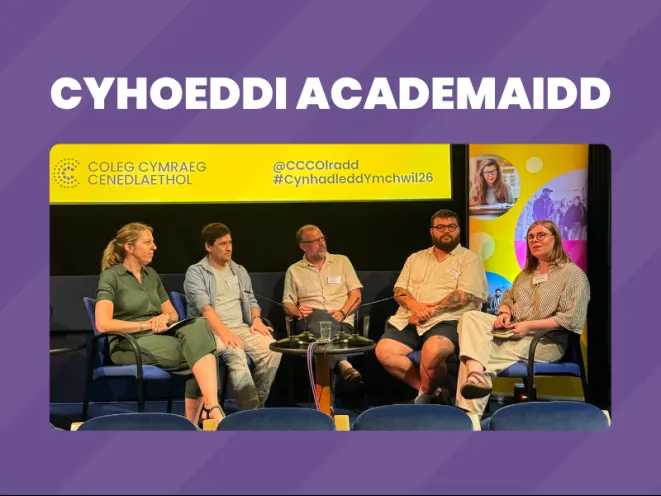
A panel of academics sharing their experiences and advice regarding academic publishing in the company of Professor Huw Morgan, Dr Hannah Sams, Dr Sam Parry, Dr Geraint Palmer-Liyu and Dr Rhiannon Marks.
The discussion is suitable for researchers who want to learn more about the process of publishing their work.
The event took place at the National Library on 25 June 2026.
Introduction to the University of Wales Press by Dr Llion Wigley.
This presentation gives an overview of the background of the press and a detailed guide to the process of submitting and publishing volumes.
Introduction to the Coleg Cymraeg academic e-journal, Gwerddon, by the deputy editor, Dr Hywel Griffiths.
Gwerddon is a Welsh-medium open access academic e-journal which publishes research in a wide range of academic subjects. Its aim is to stimulate and encourage first-class academic discussion across as wide a range of subjects as possible through the medium of Welsh, and thereby to create a store of scholarly material for the use of research students and academics.
All articles are published in Welsh and adhere to REF guidelines creating work of an international standard which is peer reviewed.
This presentation gives an overview of the background of Gwerddon together with a detailed guide to the process of submitting and publishing articles in the journal.
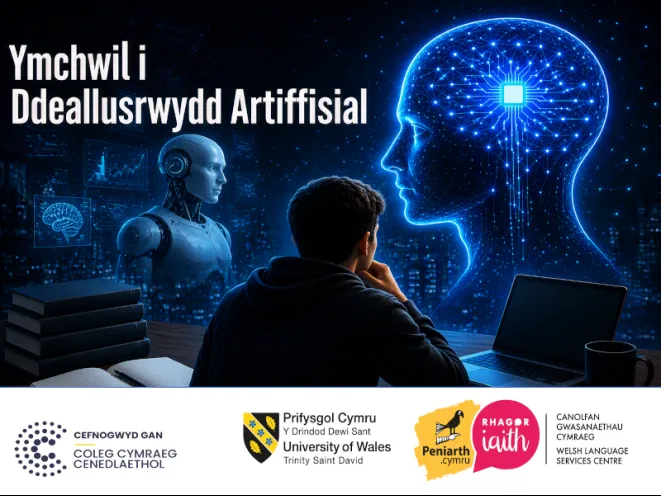
Artificial Intelligence (AI) is rapidly changing the landscape of higher education. It is influencing the way students learn, how staff design teaching and assessment, and how institutions support academic development and digital skills. While AI presents significant opportunities, it also raises important questions around academic integrity, digital literacy, equity and inclusion.
This report explores the use of Artificial Intelligence within the context of Welsh-medium higher education, with particular attention to the opportunities and challenges facing Welsh speakers and speakers of minority languages.
The report brings together current research, practical tests and feedback from staff and students to provide an overview of AI and its implications for Welsh-medium education. The report also highlights examples of good practice and identifies ways in which institutions can support the responsible and equitable use of AI. The report includes practical guidance and resources, recommendations on selecting appropriate tools, writing effective prompts, checking the reliability and accuracy of AI-generated content, and considering issues such as privacy, bias and transparency.
We hope that the report will spark discussion, experimentation and collaboration across the sector to ensure that Welsh speakers can take fair advantage of DA developments, supporting a bilingual, inclusive and responsible approach to the use of these technologies in higher education.
This resource is designed to support GCSE and A‑Level learners in recognising the components of a compelling news story lead. It is an interactive digital tool through which users can learn from one of Wales’s leading journalists, Will Hayward, as well as Reach digital journalist Ben Peris and Hannah Williams, Editor of Tafod, Cardiff University, 2025/26.
Instructions are provided at each stage on how to use the resource effectively.
Please fill in your details below to receive email notifications about new resources.
Unsupported Browser
Sorry, your web browser is not capable of supporting the features required by this website. We advise you upgrade your web browser before continuing to use this website.
The following web browsers are supported by this website:
Apple web kit UI:
Version 537 or later
Microsoft Internet Explorer:
Version 11 or later
Microsoft Edge:
Any version
Google Chrome:
Version 70 or later
Mozilla Firefox:
Version 65 or later
Apple Safari:
Version 601 or later
Opera:
Version 60 or later
Facebook App:
Any version
Twitter App:
Any version
Please contact your system administrator if you require assistance upgrading or changing your web browser. We will not notify you again about this until you next restart your browser.
Alert
Title
Account Required
Please login to add this collection to your favourites.