This Welsh-medium e-textbook is a comprehensive introduction to the process of planning and conducting research. Aimed primarily at Psychology undergraduates, it accompanies Welsh-medium research method and dissertation modules. It is also a useful resource for undergraduate and postgraduate students in a wide range of other subjects.
The authors of the textbook are Dr Awel Vaughan-Evans, Dr Gwennant Evans-Jones and Emma Hughes-Parry.
The meddwl.org website was set up in November 2016, and is run by a small group of volunteers, to try to address the lack of Welsh-medium information available to help people living with a mental health condition, and their families and friends. This is the first website of its kind that contains information on mental health issues exclusively through the medium of Welsh.
Everyone has mental health. meddwl.org is a place to get support and information, and to read and share mental health experiences – all through the medium of Welsh.
These resources present some of the key principles and techniques used in psychological research.
Each unit contains the following:
abstract
lecture in the form of video presentations
multiple choice quiz
seminar questions
bibliography
The individual units listed below are available here as one resource.
Contributors to this theme:
Emma Hughes-Parry
Dr Mirain Rhys
Dr Hanna Binks
Dr Kyle Jones
Dr Gwennant Evans
Dr Rachel Rahman.
These resources have been created with support from the HEFCW Investment and Recovery Fund.
These resources examine theories and key research in the field of developmental psychology.
Each unit contains the following:
abstract
lecture in the form of video presentations
multiple choice quiz
seminar questions
bibliography
Contributors to this theme:
Dr Mirain Rhys
Dr Catrin Macaulay
Dr Hanna Binks
Dr Rebecca Ward
Dr Gwennant Evans
The individual units listed below are available here as one resource.
These resources have been created with support from the HEFCW Investment and Recovery Fund.
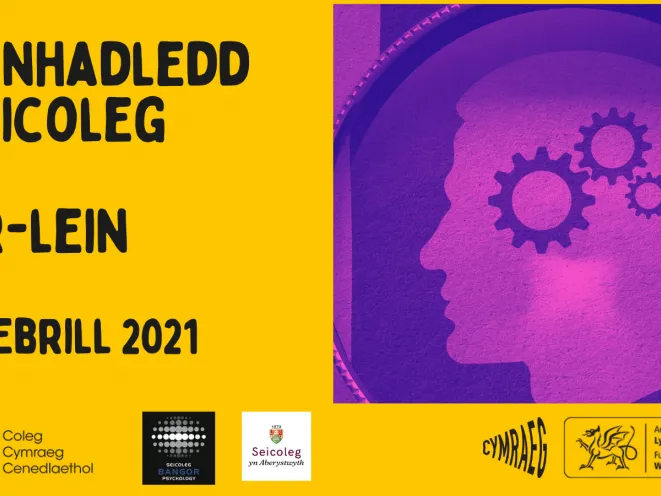
A conference held on 28 April 2021 for undergraduate and postgraduate Psychology students and those studying related subjects such as health and education. 17-18 year old learners were invited to join.
The morning presentations followed the themes of:
Health & Wellbeing
Language, Development and Education.
A Careers Panel was held in the afternoon with people representing the following careers:
Educational Psychologist
Clinical Psychologist
Applied Behaviour Analysis Psychologist
Speech & Language Therapist
Higher Education lecturer
There was also an opportunity to ask questions. The conference was held online, through the medium of Welsh
This web page contains revision resources for A Level Psychology. The resources include posters which summarise studies and revision packs for research methods. The resources were developed by The School of Psychology, Bangor University.
Rhaglen bwerus am y cyn bêl-droediwr rhyngwladol, Malcolm Allen o Ddeiniolen, wrth iddo siarad yn agored am y tro cyntaf am dreialon ei fywyd a'i yrfa liwgar. Mae Malcolm a'r teulu yn siarad yn ffraeth ac yn onest am y cyfnod tywyll hwnnw lle bu bron iddo golli popeth. Ar ôl brwydr hir, mae Malcolm wedi dod drwyddi ac wedi cychwyn ar bennod newydd yn ei fywyd. Ymysg y cyfranwyr mae Graham Taylor, Mick McCarthy, Kevin Keegan a Syr David Brailsford. Rondo, 2014.
Oherwydd rhesymau hawlfraint bydd angen cyfrif Coleg Cymraeg i wylio rhaglenni Archif S4C. Mae modd ymaelodi ar wefan y Coleg Cymraeg Cenedlaethol i gael cyfrif.
Cyfres o ddeg gweithdy ar seicoleg chwaraeon ar gyfer hyfforddwyr. Cafodd y gweithdai eu creu gan Ysgol Gwyddorau Chwaraeon, Iechyd ac Ymarfer Prifysgol Bangor fel rhan o brosiect a ariannwyd gan y Coleg Cymraeg Cenedlaethol.
E-lyfr newydd gan yr Athro Enlli Môn Thomas a Dr Peredur Webb-Davies o Brifysgol Bangor. Ac ystyried bod mwy o ieithoedd gwahanol nag o wledydd yn y byd, mae'n anochel bod ieithoedd yn dod i gysylltiad â'i gilydd mewn rhyw ffordd ac ar ryw adeg yn ystod eu bodolaeth. O ganlyniad, poblogaeth amlieithog ei naws yw'r rhan helaethaf o boblogaeth y byd. Er nad oes ffigyrau penodol (neu ddull casglu data digon ymarferol) yn nodi'r union ganran neu union nifer y siaradwyr uniaith a dwyieithog a geir, mae meddu ar ddwy neu fwy o ieithoedd yn ddarlun teg o'r 'norm' ieithyddol cyfredol ar gychwyn yr 21ain ganrif. O'r ychydig dros 6,000 o ieithoedd sy'n parhau i fodoli ledled y byd, prin bod unrhyw un wedi'i hynysu rhag pobloedd neu gymdeithasau ieithyddol eraill. Daw pob iaith bron i gysylltiad ag iaith arall, ond nid pawb sydd o'r farn fod hynny'n dda o beth! Bwriad y llyfr hwn yw eich cyflwyno i fyd y siaradwr dwyieithog, ac i herio nifer o fythau ynglÅ·n ag anfanteision - ac, yn wir, manteision - dwyieithrwydd. Y gobaith yw y bydd y darllenydd, o ddarllen y gyfrol hon, yn deall yn well natur ac anghenion unigolion sydd yn meddu ar sgiliau mewn dwy iaith.
Cynhaliwyd cynhadledd ymchwil cyfrwng Cymraeg gyntaf yr Ysgol Seicoleg ym Mangor ar 4 Tachwedd 2013. Dr Carl Hughes oedd y prif areithiwr, yn areithio ar Newid Ymddygiad. Gellir lawrlwytho copiau o'r cyflwyniadau Pwerbwynt o dan bob cyflwyniad fideo.Traddodwyd ar ystod eang o bynciau amrywiol:
Amy Hulson Jones: 'Gwella sgiliau darllen sylfaenol'
Awel Vaughan Evans: 'Trosglwyddiad gramadegol rhwng y Gymraeg a'r Saesneg'
Catherine Sharp: 'Y Food Dudes. Y Rhaglen Blynyddoedd Cynnar. Astudiaeth Gwerthuso wedi ei Rheoli'
Ceri Ellis: 'Allwn ni gynnal cred mewn un iaith, ond nid y llall? Astudiaeth o gredoau diwylliannol ac emosiynol mewn pobl ddwyieithog Cymraeg-Saesneg'
Denise Foran: 'Canlyniadau plant a dderbyniodd ymyriad ABA dwysder isel mewn ysgol anghenion arbennig'
Dr Carl Hughes: 'Newid Ymddygiad: Be di'r Broblem?'
Dr Leah Jones: 'Ymwybyddiaeth Ofalgar er lles rhieni plant ag anableddau deallusol a datblygiadol: datblygu mesurau cyfrwng Cymraeg ar gyfer ymchwil iechyd meddwl'
Dr Nia Griffith: 'Ymchwilio'r Blynyddoedd Cynnar yng Nghymru'
Ela Cernyw: 'Lles seicolegol rhieni sy'n siarad Cymraeg a gyda phlentyn ag anabledd dysgu'
Emma Hughes: 'Gyffredinoli trawsieithyddol o effaith therapi mewn anomia dwyieithog Cymraeg-Saesneg'
Yvonne Moseley: 'Datblygu rhaglen ddarllen Cymraeg yn seiliedig ar wybodaeth, tystiolaeth ac ymchwil'
Research on the acquisition of grammatical gender has shown that in many languages children gain an early command of gender. Often in these languages gender marking is quite overt and provides a clear one-to-one correspondence between a marker and the gender encoded. In Welsh, however, gender marking is more complex. It is marked by mutations, a set of morpho-phonological changes that affect the initial consonants of words, and the mapping between mutation and gender is quite opaque.
Two mutation types are used to mark feminine gender: both feminine nouns modified by the definite article and adjectives following feminine nouns undergo soft mutation, and the feminine gender of the possessive adjective ‘ei’ is marked by aspirate mutation of the modified noun. This paper presents two studies that examine children’s and adults’ productive command of gender as expressed in the mutation of nouns modified by the definite article, and adjectives modifying nouns.
Children, between the ages of 4½ and 9 years old, and adults were invited to take part in the studies. First, a semi-naturalistic study was conducted to obtain knowledge about speakers’ usage of gender marking. A Cloze procedure was then used to elicit speakers’ production of masculine and feminine forms, with both real words and nonsense forms, in a variety of linguistic contexts. Some of these contexts provided cues to gender status, some did not.
The data obtained indicated that the acquisition of the Welsh gender system is a long drawn-out process, and children have not mastered the system even by 9 years of age. Welsh speakers, even in adulthood, pay little or no attention to the possible cues present in the input. Results suggest that when a language has a complex gender system that is marked by opaque morpho-phonological processes the course of development is protracted and variable.
The aim of this study was to investigate the role of quality and quantity of linguistic input (i.e. to what extent are individuals exposed to a language from different sources during their lives) on Welsh-English bilingual adults’ acquisition of the Welsh plural system. Previous research found differences between bilingual children from different language backgrounds. While it is possible to reduce the difference with an increase in exposure to the language, however, when the structures are complex how quickly (if at all) can any difference be reduced, especially when the system is used inconsistently across adults. However, to what extent these differences reduce is unclear, as no research has been conducted on individuals over age 11. The aim of the study was to assess Welsh-English bilingual adults’ abilities to create plural words in Welsh, in order to trace the extent the differences seen between children have reduced over time.
Please fill in your details below to receive email notifications about new resources.
Unsupported Browser
Sorry, your web browser is not capable of supporting the features required by this website. We advise you upgrade your web browser before continuing to use this website.
The following web browsers are supported by this website:
Apple web kit UI:
Version 537 or later
Microsoft Internet Explorer:
Version 11 or later
Microsoft Edge:
Any version
Google Chrome:
Version 70 or later
Mozilla Firefox:
Version 65 or later
Apple Safari:
Version 601 or later
Opera:
Version 60 or later
Facebook App:
Any version
Twitter App:
Any version
Please contact your system administrator if you require assistance upgrading or changing your web browser. We will not notify you again about this until you next restart your browser.
Alert
Title
Account Required
Please login to add this collection to your favourites.