A guide for doctoral candidates on preparing for the Viva exam. The guide contains information on how to prepare for the exam, what to expect on the day, and frequently asked questions in a Viva exam. The information was translated by Y Coleg Cymraeg Cenedlaethol in collaboration with UKCGE
The purpose of this booklet is to share good practice in developing educational provision and teaching in a minoritised language in universities. The good practice covered in this booklet come from focus groups held with lecturers and students looking at their experiences of Welsh and Irish medium education at universities in Wales and Ireland.
This booklet discusses:
good practice in encouraging students to study in a minoritised language
developing provision in a minoritised language; teaching in a minoritised language
supporting students in a minoritised language
assessments in a minoritised language
normalising the use of a minoritised language among students.
We anticipate that this booklet will be useful not only for lecturers and providers of higher education in these countries, but also for lecturers, higher education providers and providers in other education sectors in other parts of the world who are developing educational provision and teaching in a minoritised language.
The summary of the resource in Irish was produced by Dr Dorothy Ní Uigín, of Ollscoil na Gaillimhe (University of Gallway).
This Research conference will be held in hybrid form again this year, on 30 June, with a face-to-face audience at the National Library in Aberystwyth, as well as a live broadcast to a virtual audience. You can find more information about the conference in the Coleg Cymraeg events calendar.
Banc Brawddegau (Phrasebank) contains example phrases and sentences which can be used when writing a Welsh-medium essay, dissertation or academic paper. It is aimed at students and researchers, particularly those who may be new to Welsh-medium academic writing.
Developed by Professor Enlli Thomas and Bethan Wyn Jones, Bangor University, based of Academic Phrasebank (https://www.phrasebank.manchester.ac.uk).
These resources have been designed to support tutors to develop their bilingual teaching skills and increase their awareness of the Lifelong Learning Welsh Record (LLWR) and the LA26 data set. The data set is used to record Welsh and bilingual provision in the post-16 education sector in Wales. The aim of the resources is to give tutors confidence in the way activity completed in Welsh or bilingually is recorded on the LLWR, and to help tutors establish where their provision currently sits. They are also designed to give tutors practical advice on how to move their teaching up the bilingualism continuum.
This tutor support pack includes:
Handbook - a working document that can be used for reference, as well as to establish specific personal targets for increasing the Welsh/bilingual provision.
Online e-learning course - Understanding the Welsh Lifelong Learning Record (LLWR). This interactive online learning module provides an overview of the Welsh Lifelong Learning Record (LLWR) and how it is used by the Welsh Government to record Welsh and bilingual provision in the post-16 education sector in Wales.
Sgiliaith bilingual glossary app - 'Sgiliaith Feedback App' - this app contains a wide range of learner feedback and general phrases you can use in your role as a tutor in order to provide learners with a Welsh/bilingual experience.
Links to the resources are available below and are also available on the Sgiliaith website sgiliaith@gllm.ac.uk
The purpose of this online self-study course is to give assessors the resources and information to work confidently bilingually with their learners.
The course considers some of the benefits and challenges of working bilingually before setting out to give information, resources and motivation that will enable assessors to develop provision and work confidently through the medium of Welsh.
The course is bilingual, and is aimed at raising the confidence of assessors as they provide their training through the medium of Welsh.
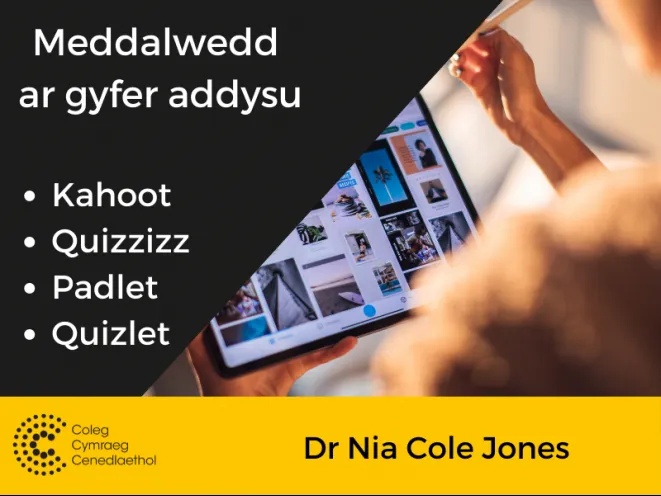
This workshop will be useful for anyone wishing to use fun online platforms in their teaching. Through this resource, you will learn about different platforms to create varied and useful learning experiences for your students.
In this resource, you will be introduced to the following platforms:
Kahoot
Padlet
Quizzizz
Quizlet
Presenter: Dr Nia Cole Jones
Dr Nia Cole Jones is a senior lecturer with the Open University. She graduated with a first class degree in Welsh from Aberystwyth University, and went on to study an M.Phil and PhD on the development of the Welsh language in sport and the news. She has worked in higher education for over a decade, focusing on developing students' language skills across all levels.
Here you will have access to health and wellbeing resources that can be used in lectures, seminars or in personal tutoring meetings. Each resource is accompanied by an instruction sheet for the lecturer.
Resources include:
Activity 1: The Wheel of Wellbeing
Directions 1: The Wheel of Welfare
Activity 2: The well-being self-assessment tool
Directions 2: The well-being self-assessment tool
These resources have been prepared by Dyddgu Hywel, Senior Lecturer in Education, Cardiff Metropolitan University.
Sources of Help
If you have a medical emergency, serious problem or a threat to life, call 999
If you are worried about your mental health, the first step to getting help is to tell your GP.
A list of helplines, charities and useful information can be found on the meddwl.org website
This resource is a collection of resources to support educators who wish to introduce more Welsh in the delivery of the Level 3 Uniformed Protective Services course.
The collection has been created to support educators in planning and setting classroom work activities or evidence based on learners' Welsh language skills.
The collection includes:
• a guide that explains how to use the resource.
• 'Mapping the Opportunities to introduce the Welsh language' document for each core unit.
• bilingual posters of the key terms for each unit.
This resource is a collection of resources to support educators who wish to introduce more Welsh in the delivery of the Level 2 Health and Social Care: Core course.
The collection has been created to support educators in planning and setting classroom work activities or evidence based on learners' Welsh language skills.
The collection includes:
• a guide that explains how to use the resource.
• 'Mapping the Opportunities to introduce the Welsh language' document for each core unit.
• a series of tasks that meet the requirements of specific assessment criteria of the course. They demonstrate how it is possible for all learners to complete the same task, whilst developing their Welsh language skills at individual and appropriate levels.
• bilingual posters of the key terms for each unit.
• a resource that provides ideas for learners to use the Welsh language on work placements.
The individual documents can be accessed below or you can download a zip file containing all of the files here.
The resource consists of four presentations:
Part 1 - Language Awareness in the Higher Education Context
Part 2 - Group Profiling
Part 3 - Bilingualising a lecture or seminar
Part 4 - Resources to support bilingual teaching
Aims of the workshop:
An introduction to language awareness in education, in the context of higher education.
Develop an understanding of the importance of student profiling and how this information can be used to plan lectures and seminars.
An introduction to a variety of practical techniques to bilingualize lectures and seminars and enhance students' language experience in English lessons.
To share useful resources to support trainees/teachers to embed Welsh within lectures and seminars.
Content:
An update on national policies with regards to the Welsh language in Higher Education.
An overview of the benefits of profiling students' language skills (ability, use and aspects of Welsh) and how trainees can use this knowledge to plan their teaching and create opportunities for students to use and develop their Welsh.
Various and practical techniques for bilingual lectures and seminars.
Advice on including Welsh key terms in English lectures.
Overview of useful resources to support trainees to embed Welsh within lectures and seminars (e.g. Y Termiadur Addysg, Ap Geiriaduron, Cysgliad).
At the end of this workshop trainees should be able to:
Demonstrate an understanding of language awareness within higher education and its impact on students' decisions to consider submitting work through the medium of Welsh.
Be aware of the importance of profiling students language skills, and develop strategies to gather information about students individual language profiles, so that this information can be used to plan lectures and seminars.
Use a range of strategies to bilingualize lectures and seminars.
Use a range of resources to embed Welsh within lectures and seminars.
Presenters:
Helen Humphreys, Sgiliaith
As a mentor and trainer for bilingualism and Welsh in Further Education and Work Based Learning, my role enables me to inspire, share ideas, resources and good practice within these sectors. Having been a fully bilingual lecturer at Coleg Sir Gâr, I gained additional responsibility within the college as a Staff Learning Mentor for the Welsh Language. This role has been an opportunity to share good practice with college staff, monitor and develop their skills within the classroom before becoming a part time and then full time member of Sgiliaith in 2017.
Sioned Williams, Sgiliaith
Sioned Williams is a Professional Development Mentor and Trainer for Sgiliaith. Her core work is to provide staff training, support, advice and resources, and to share good practice in bilingualism and embedding the Welsh language with lecturers, tutors and assessors in the further education and work-based learning sector, with the aim of enhancing learners’ bilingual skills and experiences.
The aims of this workshop are to:
• Understand who the personal tutor is?
• Introduce some of the key principles of personal tutoring
• Consider the support available to personal tutors at local (e.g. school / department) and institutional level
Contents:
Personal tutoring is central to student experiences and personal tutoring programs offer students opportunities to receive guidance, advice and support on all kinds of things during their academic journey at university. Each individual's journey is different and personal tutoring programs are expected to meet the needs of different types of students as well as respond to institutional processes and procedures.
This workshop offers an opportunity to consider some of the key underlying principles in the role of the personal tutor with reference to some expectations and practical steps that the tutor can apply to their role.
At the end of this workshop trainees should be able to:
• Define some of the main features in the role of a personal tutor
• Identify what personal tutors need to consider when tutoring
• Consider ways to support students in different situations and contexts
• Consider ways to tailor a tutoring sessions to meet the needs of the student
• Consider the importance of networking and partnering with students to develop effective tutoring approaches
• Consider ways in which students can contribute to the tutoring process
• Identify what is available to support personal tutors
Presenter: Dr Angharad Naylor
Dr Angharad Naylor is a Senior Lecturer at the School of Welsh, Cardiff University. She is the Director of Teaching and Learning and a Senior Personal Tutor.
Please fill in your details below to receive email notifications about new resources.
Unsupported Browser
Sorry, your web browser is not capable of supporting the features required by this website. We advise you upgrade your web browser before continuing to use this website.
The following web browsers are supported by this website:
Apple web kit UI:
Version 537 or later
Microsoft Internet Explorer:
Version 11 or later
Microsoft Edge:
Any version
Google Chrome:
Version 70 or later
Mozilla Firefox:
Version 65 or later
Apple Safari:
Version 601 or later
Opera:
Version 60 or later
Facebook App:
Any version
Twitter App:
Any version
Please contact your system administrator if you require assistance upgrading or changing your web browser. We will not notify you again about this until you next restart your browser.
Alert
Title
Account Required
Please login to add this collection to your favourites.